Automatic transcription, there could be errors.
Alessandro Oppo (00:00)
I actually developed the project, out of the idea of annoying my mom, who was always complaining about politics in our hometown, and, I was like, I'm the wrong person to address. Talk to a member of parliament, and she had so many. To me it was excuses, so she didn't quite tell me one argument that was valid in my opinion, and I say, okay, I think a lot of people struggle with this because they want to address politics, but they don't dare to for whatever reason. Welcome to another episode of the Democracy Innovators Podcast, and our guest of today is Thomas Lorenz.
Thomas Lorenz (00:32)
And so thank you a lot, Thomas, for your time.
Alessandro Oppo (00:36)
Grazie per l'invito. Hi, Alessandro.
Thomas Lorenz (00:40)
And would you like to tell us something about you?
Alessandro Oppo (00:46)
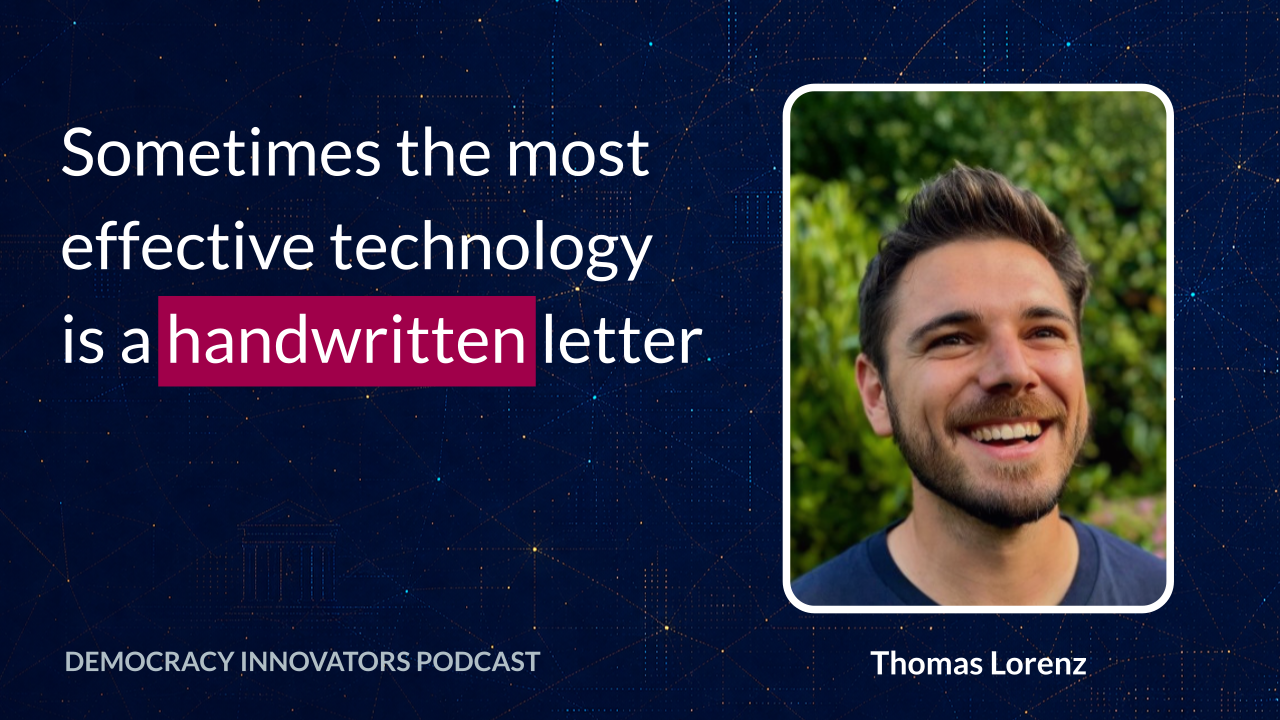
I mean, there's a lot to tell, but my most recent project, I will focus on that most. So I'm based in Germany. I used to live in in Bologna as well like Alessandro, so I speak a few words of Italian. But recently, I have developed a project here in Germany. It's called Brief Nach Berlin, like letter to parliament pretty much, and it helps people like you and me, citizens, to formulate a concern that they have or like a matter of interest and address it to their letter to their member of parliament, be it in Berlin or at their state level or even in their local commune level. And, yeah, I built, a little AI based tool, which is entirely based in in Europe, to make the best letter, and then also I kick my, my users in the ass to actually write it by hand. So they also have some sort of democratic feeling, and it also surpasses the entire written and email stack of letters on the parliament's desk because it shows that you're more engaged, and I try to use that analog way.
Thomas Lorenz (01:54)
And I saw that you also have a T shirt. Yes.
Alessandro Oppo (01:58)
No. I recently made a T shirt, and I probably have to wear it. Yeah. Exactly.
Thomas Lorenz (02:03)
Thank you. So the project is becoming serious. I know you told me that it started as a small project.
Alessandro Oppo (02:11)
Yes. Exactly. It started, three and a half months ago, maybe four by now, more or less. And I actually developed the project, out of the idea of annoying my mom, who was always complaining about politics in our hometown, and, I was like, I'm the wrong person to address. Talk to a member of parliament, and she had so many to me, it was excuses, so she didn't quite tell me one argument that was valid in my opinion, and I say, okay. I think a lot of people struggle with this because they want to address politics, but they don't dare to for whatever reason. So, I worked at a company that was working with AI to build a product and software, and coming from a political science background, I said I will develop a small tool that helps you figure out who you have to write your concern to, like who's the most eligible person to actually read the concern and who's able to change it. I find the address, I help you formulate the letter out of like two lines of what you want to complain about, And I told my mom, when I develop it, you have to write it by hand, and she gave me a handshake. She did it, and she, like three or four weeks later, she got called by a member, of parliament office, and she even got visited by the people, and they entirely solved her matter. And now my mom is like a big, how do you say, democracy multiplier in my hometown, and I said, I have to make this bigger. So that was like three or four months ago, and by today, it's almost 2, 400 people who have used the tool, and it's it's growing steadily. I've been in some newspapers, talked to a lot of people, and, yeah, tried to spread the news also in Europe. So, I'm entirely open source and people can double check it. I would like this tool, which is entirely free and financed by myself, to grow in Europe and in the world. So, yeah, I'm open to suggestions if you have any.
Thomas Lorenz (04:16)
Yeah. And the and the fact that you study political science is quite interesting because I think that maybe for a person that study, yeah, political science could be obvious that if you want to complain about something, you have to write to someone that is inside the the parliament or the municipality. But maybe for people that studied something else or they did something else, it's not so obvious. And so they don't know what to do if there is an issue in the Yes. Exactly.
Alessandro Oppo (04:50)
I try to pick that up, but also I try to, make it ridiculous to not believe your own excuse of not doing anything about complaining, because it's so easy and so fast. And, since I don't save any data, I try to spread the words to write a letter to Berlin because that's what it means, and I would like more and more people to actually use it and feel the power. And, Alessandro, I remember we talked a week ago also about somebody becoming mayor and they stopped receiving letter from from their citizens. And I hope more and more people actually soon dare to actually write a letter to their mayor, to their local member of parliament in their town, in their community, to actually address what needs to be addressed, like maybe a missing parking lot, a missing bike lane, a construction site that's never ending. We have that in both Italy and Germany, or maybe bad Internet connection at my house, which is also crucial infrastructure to a lot of people, especially to someone like me who studied political science and by accident actually got involved with artificial intelligence and building services with it on the internet, and this is my most fun project right now.
Thomas Lorenz (06:12)
Yeah, I think that this is one of the most exciting things about AI that allows all the people that have maybe knowledge about society, about politics to being they become able actually to create a project or to create something that can be useful to other people too. Because in the past, I mean, three years ago, you had to invest a lot of time and money to build, let's say, something like that. And you had also to to have the skills related to computer science. But often there is let's say, division of knowledge in society. So the people that know how to code, they're not maybe so interested or they don't have the knowledge about the political structure. And and, yeah, I was wondering if you also had other ideas about if you got in touch with other projects.
Alessandro Oppo (07:12)
I actually talked to a lot of people and since my project has been growing, so about three and a half months ago, it was picked up by one of the biggest politics podcasts of Germany called Lage der Nation, like state of the union, state of the nation, and they spread the news. And ever since, it's been growing, and I've been interviewed by papers and and now by you or, like, other people who spread the idea. And, yeah, I try to expand my ideas, and I also have ideas to maybe develop other projects to strengthen the feeling or efficiency of of democracy, be it at the local level or even, like, on a state level or European level. So, should we come up with, another nice app idea in in this talk? I'm very open to, procrastinate with that as well. Oh, yeah. We can, have,
Thomas Lorenz (08:05)
have some ideas actually. Like Yeah. Let's let's go for it. Something that will be very interesting, is that, a lot of time in society, we think that, we don't realize that an issue that we have maybe is not an individual issue, but a collective issue. And I'll make this example. I think I did it in some other episodes about, let's say, if I fight with my brother. So I can think that, I don't know, my brother is annoying. I can think that yeah. But then at the end, a lot of other people are fighting with their brothers, then it means that it's a collective issue. Maybe in our town, their homes are too small and we don't have a room for each other. Or could be something else. Like maybe, I don't know, I want to exercise, but I don't have a place where to go. So maybe there is not a public park and it is the same for many other people, but it's hard to realize it. Or maybe I want to stop smoking, I don't know, but all my friends are smoking. And yeah, a lot of times we think that an issue is just affecting us because of the condition that we have. But a lot of times it's a it's a society it's a problem that is is related to many other people. And I I think that it will be very nice to also think about something Mhmm. For this problem. But how to do it is is the question.
Alessandro Oppo (09:50)
I think you have to have a lot of data collecting and comparing it to it, so it had to be very strict in terms of how to deal with the data, and also a lot of people have to actually use it for the data to, to matter. Because if it's just four people in your neighborhood, it's it's a lot. It's more than zero, but it, cannot quite reliably, point to a certain kind of indicator. I think if a lot of people would use it, that could happen, and I think the data, I'm not quite sure, but the big AI companies, they do collect a lot of data, especially when you do not pay for using it, then you pay with your data as of any product, that you use in the internet. I think they actually maybe could, use it for this kind of thing. I'm not quite sure how they collect data to personalize their offer to you, but I think they could use their technology and their data collection for a good cause. I think me being a small person, that would be quite a challenge to get a lot of people to use it to complain. Yeah. But I don't wanna I don't wanna say no. So maybe in the future, I can put my head together with some other people who want to build something like this. I was dreaming of some sort of platform or, like, chatbot where people can get into after they wrote their letter with Brief nach Berlin because the process right now is you complain in a little text box, then the letter finds the person who you should address, so which political level is responsible, then helps you formulate your letter. You get kinda like a draft sent to your email box for how long it is, and, you can tweak it as well if it should be a bit more, polite or if it's a bit more pressing towards your politician. And then I ask you to actually copy it by hand. And I think how I perceive it right now, since a lot of people then also text me like, thank you. You helped me overcome my procrastination. I always wanted to do this, but I haven't never done it. And they feel very activated, and I think they are activated in a political way that they don't feel, like a like a passive citizen anymore, you know, like stuff does not happen to them, but right now they start to take action. And I was dreaming a bit of sending them an email with both the letter draft and also some instructions of how to make it the most effective outcome, but also give them the next step, you know, of going not the first, but the second step towards being more democratic or more politically active. And I was dreaming in my head and discussing with some other people who are very engaged in civil society what this app could be. So maybe a chatbot of saying where do you live, what do you want to do, what are your hobbies, how old are you, how how much time do you have each week, and maybe then it goes through a database and checks this kind of volunteer work would fit you perfectly. You will get a lot of live people, and next Tuesday at seven, you said you're free. You don't have anything to do on on Wednesday morning. Why don't you go help, I don't know, clean up the streets in your neighborhood? Some volunteers always meet up close to you, like, two minutes cycling. Or maybe it helps to go to an elderly home and read to people with dementia or this kind of stuff. And I'm dreaming of of this kind of idea to connect one that I have and to kind of use habit stacking, you know, so I kind of like sent you an email, you want to change something, and then I give you the next step and say, you wanna go further and nudge and push you, further down the line of becoming more politically active. So, whoever is listening to us right now or also tomorrow, please let me know if you have ideas, if you want to contribute, if you want to bring a Brief Nach Berlin letter to parliament to your country, I'm more than, open to help, to spread the word, gather ideas because, yeah, democracy is a bit under attack in Europe and all over the world these days.
Thomas Lorenz (14:01)
Yeah. And these things about, AI companies that collect a lot of data, let me think many times about, also how much they know about society. I mean, I think it was the same also before AI if we think about Google and other big tech. But with AI, it's even more explicit because we ask questions that are very specific, and so they know a lot about us. And, also, I was wondering, what if in the future they also want because as an example, for ChatGPT, it will be way easy it will be very easy to understand what citizens want in a certain country and also the kind of language to build a narration that can be effective. So I was wondering what if they, you know, if they also become part of the political environment. I mean, they're already they're already part of the political environment, but not so directly. And because it's true that you have to have a lot of data to discover all the issues that, are not affecting just one person, but, broadly all the society. So I don't know if you had any thoughts about about this or maybe
Alessandro Oppo (15:31)
I I think to speak about one aspect of what you just mentioned, What one could do right now is analyze how Google is used because you can see the keywords that are used. I think you can also filter it down towards certain regions in a country or a city even. I'm not quite sure about this, but this could be an indicator that you could tap onto right now. But since Google is a bit in the decline because a lot of people also turn to ChatGPT and other AI platforms to look for answers that are quick, I think it might not be as representative and as vastly used as it was, I don't know, two or three years ago. But, yeah, I feel that there is also a potential danger. I'm very I I enjoy using artificial intelligence as a tool, but I also see the potential harm it could do to societies because it makes it so easy to not ask any human anymore or to go into conflict and it just helps more individualization, isolation a little bit, but it also gives us the illusion of a perfect answer. So if nobody discusses anything anymore, we ask ChatGPT and there is one answer coming, and it's fast, reliable, and sounds cause how do you say plausible to us, it is a heuristic or maybe a lazy heuristic of today's world to just believe it, not challenge the thought. But in general, yeah, I'm very skeptical towards the power being abused, of this super powerful technology to shape laws, in in the European Commission to, yeah, to use a lot of power and dependence because right now, since it's so cheap or apparently so cheap, in the short term for both companies, individual people, and also for people like me to use it, I will get very used to using it, and should they soon raise prices, which they will have to because they're all in debt, I think, the only exception is NVIDIA right now. They're battling for who wins the monopoly race and then, raise prices heavily, I guess. And, yeah, I think we're all very dependent in the future on this kind of technology, and then we have to pay at one point. So,
Thomas Lorenz (18:01)
yeah. Absolutely. But, and also from our cultural point of view, I saw that, I mean, it is true what you said about the reply of an LLM that is, like, you know, it's perfect, credible, easy to read. And, I also saw that, well, in the past to do, like, a complex project, you had to, yeah. Or to have money and so that you could pay someone else, or you had to cooperate with other people. But nowadays, it is like it is easier to maybe relate to a to talk to an LLM and tell to the AI what to do instead of having to deal with other people and to collaborate with them because collaboration is very hard, but still I think that is something important. But, yeah, I also understand, and it's also happened to me that sometimes instead of having to deal with other people, I was just going to ChatGPT or or Yeah. This is something that, I saw and, but I think it will be very important, for society to collaborate on different issues. And also we Dana, please.
Alessandro Oppo (19:29)
I think that it can also be like a false friend in the way that I think the pace that we are all expected to actually, put work in, put labor in to produce something, be it code or, I don't know, something at work, we are expected to be more and more efficient with this tool. So, I can imagine that stress levels will rise and people, might be more likely to burn out. And also, in my case, I have, worked a lot with artificial intelligence and I feel very confident in using it to producing code even though I'm not I I can read code a little bit, but I could never have created Brief-nach-Berlin so fast and so well working without this technology. So super powerful to also boost AI, and I enjoy using it as a first step for people to actually doing something analog and use their pen and write their letter and feel the paper and, you know, lick the stamp, the francobollo, put it on on the letter and put it send it away. It's an act. It's very cognitive. It requires a lot of senses, you know, like touch and feel and, yeah, maybe even taste depending on on your stamp. And I think you will remember sending a letter that you wrote one one page, one and a half, or two pages because most of the people, they do not remember writing the last letter because it was so long ago. But if you do today, you will I can ask you last year, did you write a letter to your member of parliament? And you will very confidently say, yes. But if I ask you about what you did on on ChatGPT or, on WhatsApp or texted, you will not be able to be so sure because there's very little friction involved, there's very few senses involved, and we do that transactionally so many times in a day. But also when it comes to artificial intelligence, I look forward to how the European Union will be able to regulate in terms of privacy and also market share power, but also allow us to profit in a good way to use this technology, but it can also lead, and that is also was in my case, to something I would say is productive procrastination. So, you feel like you're doing so many things at once and you have this genius idea of this new app or this automation that helps you. But I think a lot of people, including me, also have been fallen into the trap of perfectionizing something in silence and making it great for other people to use or even for myself, but in the end, I was just procrastinating, but it felt productive. So, I think it can also, yeah, make us fall in into this kind of trap as well because we can do so much in such little time, but if we step back and breathe and maybe not look at a screen for that second, do we even need what we built or do we even need to write so many emails? But what about sending just one letter to parliament instead of five, I don't know, AI emails to five constituents? So I would say go when you want something effective to happen, take your time and write a more personalized letter or construct something that is where you actually know the proven benefit will occur than to just start doing it and lose two weeks of doing it, but feeling productive, but I think it can also lead a bit to anxiety. I don't know if I was very clear about, what I was just said.
Thomas Lorenz (23:13)
No. I think yes. I understood you. Okay. Good. And, yeah, I was also thinking about, before about the fact that, your project is, quite simple in a way because it doesn't, do anything so complex, But it's simple in a good way so that people understand what the tool is doing. Because I think on one side, probably I could also go to ChatGPT and write this issue down, write me a letter and find who is the the person I should write the letter to. But maybe many people don't have this I mean, it is easier if there is a tool. I just go there, and I don't have to register. And, yeah, I totally agree also about the fact of procrastination, and I've seen it also myself, the on other friends and people that I know. And and also about this, before I was talking about collaboration and nowadays with the software being so easy and cheap, I think that collaboration is even more important because otherwise, I don't know, you build your tool in Germany. I build the same tool in Italy, but maybe we can have like a sort of cooperation. I don't know. You build the back end, they build the front end, the different ideas integrated. And, also, there is a yeah. I mean, we will save both human energy and also electric energy. Yeah.
Alessandro Oppo (25:00)
And we can have more free time. I mean, that is a nice thing because in this very hyper stressed world, I would say, where we are all, you know, on our phones constantly and everything blinks and we get notifications, it's also nice to to shut off every now and then. And I struggle with that myself as well because it's so tempting to give in to this technology, which is perfectly designed by psychologists and very capable and smart people to actually draw my attention towards those platforms. But, yeah, as you said, I tried to make the tool so simple, and I did not reinvent the reinvent the world. But it actually just looks for using your matter, checking it has, like, a mapping in the background of who is responsible for your postcode. So you put in your your ZIP code, which in Germany are very simple. I think in Italy and Portugal where I lived before, it's a bit more, bit more tough, but you can find, an easy mapping service online. Most of what I used was open source as well. And that's what also led me to build it open source to both strengthen credibility, but also to say, okay. Here's something so simple, and it's super effective. A lot of people feel, like they're civically engaged. They write letters to their parliaments to be more in touch with citizens and, politicians, which I, think is a big struggle in today's world of multi corporate interests, and I decided to go open source. So other people in Italy, in, Czech Republic, in Poland, in Portugal, or even The US or wherever people are listening from, it's super easy to clone my app to your country, and I heavily invite you to do so and contact me. I put it all up. Everything is, is transparent, especially to save this time. It may be to, to not start from zero if you want to build it in Italy, but to start at 80%, and you could push it easy to 90 to a 100% of a working prototype and then, start building it on your own. So I I heavily embraced this, this open source boost in the past years.
Thomas Lorenz (27:16)
And I wanted to ask you, like, a more political question, like, what is democracy for you? And also how do you think that democracy could evolve if we use this kind of tool? So if there is more participation, basically.
Alessandro Oppo (27:38)
Mhmm. I think back in the day for me, democracy was voting every four years, at least in Germany on a on a national level or every two years if you count, you know, the switch between or depending on where you live for states, national, and community. But today, it is so much more. Democracy for me was also being able to to live in Bologna and studying Bologna with Erasmus or going to Lisbon where I where I have lived almost four years in such an easy and safe way where people cooperate. And for me, it is, yeah, the closest thing we come to freedom and, yeah, also freedom of expression. I know these are very big terms, but I think to me it is the water that I swim in pretty much, and I want to preserve it and and strengthen it. And I think democracy will evolve. It has to evolve. I mean, that's what people do in parliament every day. And maybe for short periods of time, it goes into a wrong, very reactive way and not a very proactive, vision following approach, which I think has to be highly sustainable, integrating more people and more opinions, and establishing and strengthening formats and structures so people can get more into exchange. So when I talk to people that are outside of my own political belief bubble, that I don't need to be afraid that they take over. But I think, yeah, I I don't agree with you, but I have to respect you in a certain letter way. And I think technology can help to bring people together, but right now, it is heavily abused for specific interests to divide us into very individual, bubbles to shout, to seek attention and emotionalize. And I remember when I was at school, and I was, in a political science class at my school, and I was like, oh, this is so boring. You know, because I learned how the political levels were working, what bureaucracy is, how do you vote, how's the chancellor in check with the parliament and the opposition, and blah blah blah. And looking at today's news from across the pond or even in Europe or The Middle East or whatever you want to call different regions of the world. I wish it was boring again. I know it's a very Euro centric way of looking at it because it was very boring in Germany, for example, at the beginning of the two thousands when I was at school, But I hope a lot more regions go back to that kind of state where politics is is a more calm way of dealing with actual problems to not solve them because it's a continuous thing. There is nothing you can solve in politics eternally, and it's it's good forever, but that people can come together in a very constructive way, ask the politicians to be responsible with their vote, and, yeah, ensure that we have a democratic future in in front of us.
Thomas Lorenz (30:53)
And have you had any thought about, I don't know, because now we have a representative democracy that is, let's say, the the old Greeks, they would have they would not have called it democracy. Mhmm. And so I was wondering because now technology also allows people to, let's say, vote about everything or maybe to to comment about, policies and so on. So I don't know if it could be a direct democracy, direct and representative together. But, yeah, I'm very curious about, what is the next democracy, let's say, the next, possible democracy and, yeah, how we can use technology in the best way because a lot of times we use it, or to yeah. Maybe for the bad, not not for the right goals, let's say. Mhmm. Also, as you say, the social networks, are not made they're made to to for us to stay in specific bubbles. And, yeah, I'm very curious how we can use technology, also to yeah. Let's say to have a boring political, environment. Because, when the political environment is interesting, it means that there are bad times. Usually, dictatorships, civil wars.
Alessandro Oppo (32:31)
It it's it's polarizing. I mean, boring can also mean, maybe for the people in Russia, it's very boring because they cannot change anything anyway. They just watch the news. So we have, like, two sided thing. I think in a democracy that's well working. What I meant with boring, it was, okay, stuff is happening, and it's happening for the good, and it's kind of rational to the challenges that we face as a group, as a huge anonymous group of, let's say, the people of Germany, of Italy, of Portugal. But democracy and and tech, they can go there will always be a struggle, I think, in between. But if you find and create laws and, institutions that incentivize democracy boosting, behavior, I think technology as a whole can aid democracy, state level institutions, and even economics in the long run to not be very shortsighted, to follow shortsighted incentives that we have, like the best quarter earnings to get the best dividends to people who hold your stock, but maybe to say, okay, we created, a way to incentivize people to look more in the long run, to not look into the next quarter, but maybe check the next four or five years, and we have kind of like a polar star where we're all going are are working towards. I think technology can help to bring people together because life today is so complex, and I think especially with artificial intelligence, there is a technology that can recognize pattern for us where we would take a lot of time to, you know, make it work. And I'm super curious who comes up with some nice idea that can strengthen this kind of politics and not abuse it for surveillance and power abuse but to use it to bring people together. But for me, I think that also always means to use technology, to bring people together, and then not use technology for a while or to not look at the screen, but actually give, you the most valuable resource that I have, which is my time and my attention. So I say I put my phone away or I put it in my pocket and not have it sit on the desk or at the table. I give you my full attention, and I look for the cues you have in your face. Are you doubting what I'm saying? Do you follow my my arguments? Do you have a better idea than me? And do you challenge my worldview, but not in a way that I have to defend myself, but I can say, yeah, I think I think you're you're onto something. And the second part, referring to your question, is a bit I think, I totally underestimated before I studied, especially before I went on Erasmus in in Italy and in Portugal, how the culture and the history of a territory or a nation or a country, however you want to call it, heavily influences how people engage with with a society and their expectation. Just recently, I listened to a podcast about Meloni and how she struggles also with with the big lawyers and the state institutions in the country, but even right wing people who support Meloni's view of the world or would want her to go even further, there's a very big patriotic view of protecting a very anti fascist constitution of Italy. So there's like, how do you say, a patriotism towards the constitution, towards like, maybe Garibaldis Italy, let's say. And in Germany, it is completely different. So how our checks and balances would have to work in terms of how we inherit it from our ancestors, parents, whatever, it I think it would lead to a different kind of outcome if you put it together. So I find it super interesting how we inside the European continent, the European Union, have different approaches of how we want it to work. You talked about Switzerland kind of in a way, you know, they have a more direct democracy, but they're also smaller country. Then you have some sort of like Norway who have like a king again, and it's kind of like a monarchy, representative monarchy, but with, well, mostly democratic terms. So I I'm really curious, and I'm very optimistic that we will have to figure out in the twenty first century to deal with AI and other digital technology to actually make it work, to be pragmatic about it and not be too proud of one's own opinion, but wanting to cooperate, build alliances and embrace the other, but always looking towards protecting democracy first, and not to just go towards, felt or perceived efficiency kind of like in China who feels to be so much faster in certain technologies or just fixing a road. Apparently, in China takes two days, and in Germany, it takes one and a half years. But I still don't want to live in China even though I find it super interesting, but I feel a lot less supervised and, yeah, I I feel a lot more free when it comes to living in Europe than to living, somewhere else in this world. And I feel also very fortunate and lucky to be born, here.
Thomas Lorenz (38:28)
You haven't said how much time we take in Italy to fix a street because we don't fix them. Nice. Because yeah. I I saw that different countries has different level of speed in relation to everything. And so so, yeah, the culture is quite important also in relation to politics. Yeah. Especially like Italy and Germany, they are, quite different. I I never lived in Germany, maybe in the future. But, yeah, I see this difference. And, there was something I wanted to say that I just forgot. Yeah. If you want to say something because I forgot what I wanted to say.
Alessandro Oppo (39:20)
One one idea I also had in my mind is how much, like, I have a very strong opinion, for example, when it comes to fixing roads, be it Germany, Italy, or wherever, but have a very weak concept of what has to happen so a road is fixed. I don't know who actually has to do it to be involved. How do I call them? What is it in terms of, like, law? Like, who can I order to get this road fixed? So I think we totally under complicate in our heads what has to happen, and I have a very strong opinion that it should happen the next day. You know? But maybe the company is fixing roads outside of town right now, or it's, like, too expensive, and it has to be, like, a public announcement. Hey. Who wants to fix this road? And people compete against each other. So I think technology in the future can also bring this together, you know, like, more of, like, knowing and and being able to deal with it and being, efficient in terms of fixing, stuff, but also helping other people to say, hey. You can be very you can be very emotional about it, have a strong opinion, but it's also never, never as easy as you think it is. Sometimes it's over complicated. I think in Germany, we have so many rules that prohibits us from actually being pragmatic, But also sometimes I enjoy that I grew up with so many rules because in Germany, I can rely on public infrastructure, and I can actually sue people when something is not working. It takes a lot of time. Yes. But looking at at other states or other political systems, I feel I feel lucky, but I also feel, how do you say, I feel very annoyed sometimes. You know? And when I go to Italy, feel like, ah, people are on the streets more. The coffee is better. It's cheaper. And I I feel more, alive maybe sometimes because I think Germany is such a weird fetish towards work and productivity. But I think it also is my opinion because I grew up my normal state is Germany even though I've lived abroad in quite a few countries. But since I know so much of what is happening in Germany and I have a feeling of how it works together, I feel worse about Germany than I may feel about when I'm on vacation in Italy because yeah. You know what I mean? Like, I know so much more of of Germany and how it works and should work because I know I don't know. We're so productive. I don't know what you want to say about us. But, when I go to Italy, yeah, I sometimes feel like we're also behind in a certain way. And I don't know if if if you come to Germany and you see, ah, shit. There's not so many coffee places around, but you enjoy a clean park or, which we don't quite have in Bologna. We had the little, Trecento Scalini outside of, in the Southwest, which is beautiful, but I love the parks in Germany, like big parks. They also didn't quite have that in Lisbon. There was a lot of little gardens which were beautiful, but a proper park. That's that's a very nice thing.
Thomas Lorenz (42:38)
Yeah. Yeah. Yeah. And also I was thinking about two things. One is that, about all the rules and laws that, many times they also contradict themselves. And I mean, I also think that, rules and laws are very related to power relationship. So the fact that you can interpret the law is based on who is in power in that moment, who has the power at that moment. And so I was thinking about maybe how AI could help maybe simplify what is contradicting, the different contradictions. And then also, it came to my mind what I wanted to say before about the different countries and the different ways of, different political systems. Because I I feel like that if we use technology to simplify, let's say, the administration, then that is probably what it makes the what is the big difference in term of time. Because then I I think that to build literally to fix the street in China, in Germany, or in Italy, the people that fix the street take more or less the same amount of time, okay, based on the machines that they have and so on. But probably the main things is how to on on one side, the political things to say, okay, that street has to be fixed. Then with which kind of money? Where do we take the money? And then who is doing that thing? I mean, my cousin or, like, or, like, am I doing like, how do you say, like a ban like, that people have to do an application, and so they are selected, to fix the street.
Alessandro Oppo (44:41)
To apply?
Thomas Lorenz (44:42)
Just Yeah. To apply. Yeah. Okay. I will look later. And and, yeah, I was thinking that maybe this is going to happen that the let's say the state become faster and faster. And related to this, there is the agentic state concept vision paper. I don't know if you had the chance to see it. It's a quite interesting project because they basically say, like, citizens now are used to, to quick services. Like, I don't know, you order from Amazon. The next day you have something. Mhmm. You receive the package. And, and it is the same with everything while the state is still slow. Mhmm. And, so if the state doesn't become also responsive as, let's say, the private companies in the tech sector are, then the state will lose and basically will not exist anymore. Then, it is interesting to think about what is the state. So if it is the entity that has the monopoly of violence or more like the administrative things. But yeah, I feel like that a lot of things could be simplified, let's say by technology. And this doesn't mean that we will live in a better society, but at least maybe street will be fixed in a quicker way. So
Alessandro Oppo (46:19)
this Yeah. I look forward to specifically for the, bureaucratic processes to be more streamlined, more comprehensible, and also to be used on my phone. You know, when I'm sitting in the tram and I have to go to work in my commute, I can, you know, say, I don't know, my my child needs a new ID, and I can click on it on a phone and it's super fast. That would be amazing. I know in in Estonia and some Nordic countries, they are also very, very far. And I think or I am sometimes surprised that I don't notice German politicians going there and saying, how did you do it? Tell us, and we incorporate it into German and put some label of on top of it, like data privacy, which is super important. It's like a religious concept here in Germany. I I really hope, this this will actually boost the processes, of normal citizens having to deal with the state. Because right now, for a lot of people, dealing with the state means, yes, maybe voting, in terms of democracy, but dealing with the state means to check that everything is correct, you know, that that I live in a certain way, that when I want to build a house, every paper signed and filled is sent out. And if that process of dealing with the state of my state, I am part of the state, right, is painful. I am not a big fan necessarily. I don't feel like I want to defend filling out so many papers that I have on my desk and all the information I get on actual paper. In the contrary, looking at Brief-nach-Berlin, for example, the little project that I have, it can be funny that in the future, things are more going to be digital. But I think the more this is going to happen, the more important and more effective it will be to actually write a handwritten letter when you want to complain about something or actually say, why are we still so analog? And you send an analog handwritten letter because it is always the exception. It will always stick out. You know? Let's say, you receive so many messages or emails, but the actual letter sits on your desk. You cannot swipe it away or neglect it or artificial intelligence, have it be summed up and summarized and sent away. It takes more time to actually look at this piece of paper, and this piece of paper, handwritten specific, feeling in your hand. Right? So you it's not quite legible. It has a very personal touch to it. It's a very costly signal of someone to spend time and go the more complicated, the longer and more costly way, than to just send something AI written that I haven't even read to to my member of parliament. So I look forward to having both things. So if you actually mean to complain or even want to say thank you to your member of parliament, they work long hours, don't see their family as much, It's a very tough job. This kind of personal note is a very, very effective pattern break for the receiver to see, okay. Somebody actually means it, takes time, and sends me a personal thing, but also for us ourselves because since we're more and more looking at technology and in the future, hopefully also dealing with state matters, bureaucratic matters on our phone, on our laptops, iPads, or whatever future technology we use. It also is something for me to actually sit down, be very conscious about taking the pen, taking the paper, writing down what I actually want fixed and knowing I am responsible for sending this piece of paper to Rome, to Lisbon, to Berlin, or Washington DC. And I think these two different technologies, two different approaches towards sending a message, sending information somewhere, I think they can go hand in hand even though they're totally contradictory. And I think that that to me is fascinating. I hope we write even less letters and fill out papers in the future, but if we do, we really mean it. And that will be true for both the person who writes it and the person who receives it. It can also be a postcard. Right? Back in the day, I saw so many postcards everywhere when I traveled with Interrail on my first time in Italy, and now they're very rare. You can still buy them. They've become ridiculously expensive, I think, for a printed piece of cardboard. But back in the day, there were so many postcards to choose from, and today there is very little, and most of them have become very ugly, I think. But when I receive a postcard, I always feel like, oh, wow, this person I wasn't expecting this. This person took his time, put on a stamp, went to the post office, and, miraculously, the Portuguese post office, CTT, made it happen that this thing did not, go to waste, disappeared, but it actually reached all the way from across the world. I think that's that's super neat. It's something uniquely human that I feel like something that you have crafted yourself, is in my hand, and it took you some time to actually do it. So yeah. Yeah. I see these these two aspects.
Thomas Lorenz (51:37)
When I was a kid, I was collecting stamps because they were traveling all around the world. Mhmm. So I really, really like real letters
Alessandro Oppo (51:47)
and stamps.
Thomas Lorenz (51:49)
And and, yeah, if you have a, let's say, a final message for all the people who are working, on things related to democracy, maybe with technology, maybe without technology, like a message to them?
Alessandro Oppo (52:04)
I would say work open source, do a little bit of advertisement for your matter online, so people can find you on LinkedIn, Instagram, and the other weird platforms we are dependent on from, from The US, in order to reach a lot of people like I'm trying to do here in this podcast. Talk to Alessandro, maybe have some idea made together, and let's, let's connect. If you want to copy Brief-nach-Berlin, Letter to Parliament to your country, you have an idea or you know your cousin is experimenting with AI, let's get in touch with me. If you have an idea that could work in Germany, feel free to contact me. You can go on, I don't know what it's called, www.brief-nach-berlin.de, and you can find my email address. Let's get in touch. We have to all work together in a very pragmatic way to reach a lot of people and, yeah, save save democracy, improve it so it withstands the challenges of time. Thank you, Thomas.
Thomas Lorenz (53:12)
You're welcome. And if if you want to add anything else, otherwise,
Alessandro Oppo (53:16)
thanks for your time. Thank you.

Member discussion: